

You reach the 22nd and the money is gone. There was no big purchase, nobody did anything reckless, and it is short anyway. It feels like the money vanished, and since there is no single expense to point at, the explanation that is left is always the same: either you earn too little, or you are simply hopeless at this.
It is not really either. The money does not vanish at the end of the month. It vanishes all month long, in pieces, and the end of the month is just where you notice. Anyone looking for the guilty expense will not find it, because it does not exist: there are thirty small ones, each perfectly reasonable at the moment it happened.
And there is a simple reason this is so hard to see on your own: the brain stores decisions, not repetitions. A new television stays in your memory for months. A daily coffee does not stay there until the evening.
Does the money disappear at the end of the month, or all month?
All month. What happens at the end is that the balance stops hiding it.
While there is slack in the account, a small purchase has no visible consequence. You buy, the balance drops, it still looks like enough, and nothing tells you anything. Only when the margin runs out does the next purchase, identical to the other thirty, start to hurt. It is not the purchase that changed. It is where in the month it landed.
This is why the end of the month always feels worse than the start, even when the behaviour was the same from the first day to the last. And it is why the resolution to "spend less at the end of the month" never works: by the end of the month it is already spent.
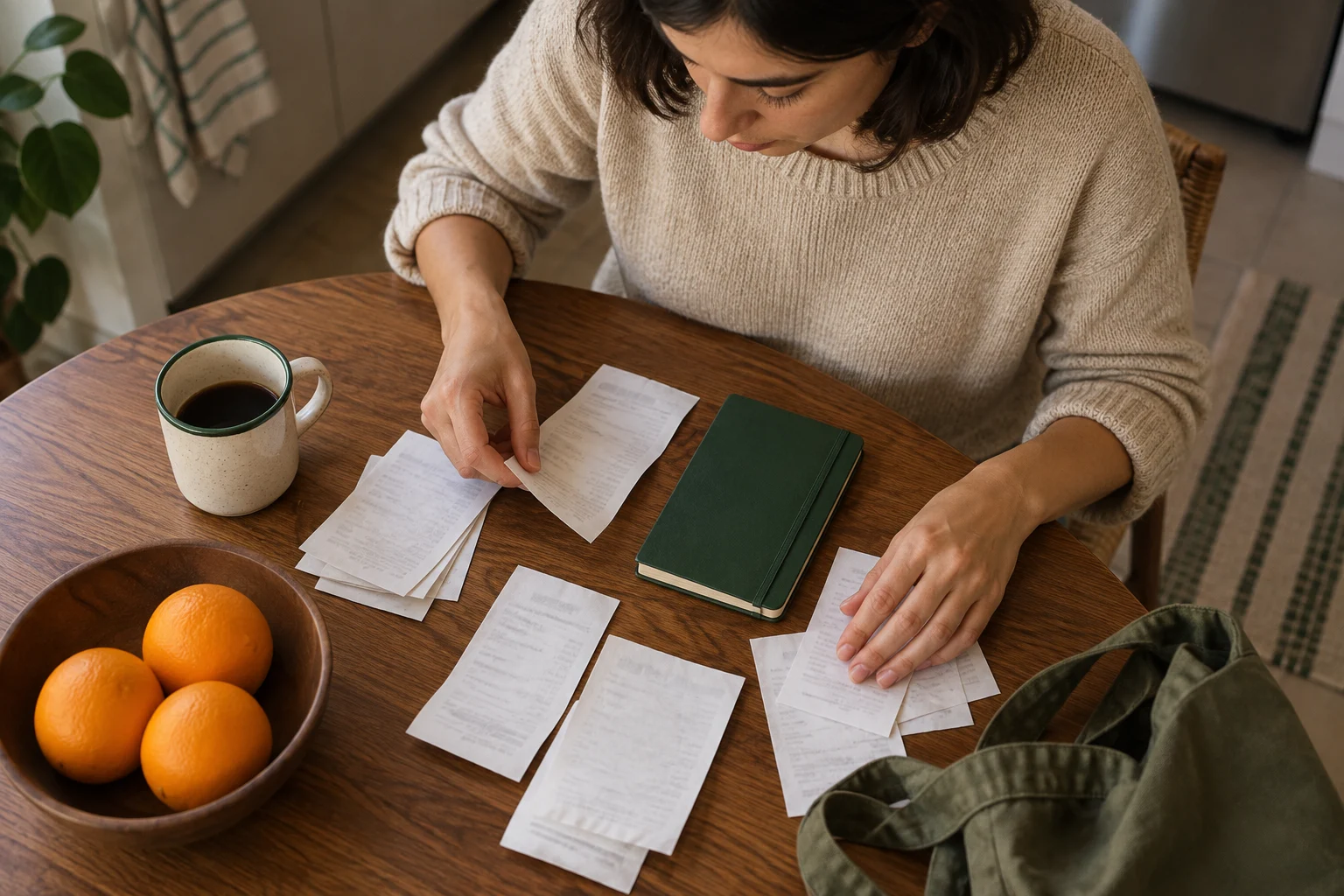
Why don't small purchases stay in memory?
Because they were not decisions, they were automatic, and memory holds very badly whatever did not require thinking.
Notice the difference. Buying a fifty-euro coat is a decision: you hesitate, you compare, you put it off, and three months later you still remember it. Paying four euros at a counter on the way to work is not a decision, it is a gesture. You do not hesitate, you do not compare, and in the evening, if somebody asks what you spent today, you will say "nothing much". And that is true. On its own it was nothing much.
Add a second effect: small amounts round down in memory, and large ones round up. Three eighty becomes "three". A thirty-two euro dinner becomes "thirty-odd". By the end of the month the sum of what you remember always sits below the sum on the statement, and the gap is not small.
Contactless takes away the last brake there was. No notes leave your wallet, no change reminds you how much was in there, nothing marks the moment. The purchase stops having a body.
How much are small purchases usually worth?
Enough to be one of the largest categories of the month, and it almost never appears as one.
I did the sum with the whole month worth 100, so it does not depend on what you earn. Picture three entirely ordinary habits, none of them excessive:
| What happens without being decided | Times a month | Weight in the month |
|---|---|---|
| A coffee or a snack on the way | 20 | 3 |
| Lunch out instead of bringing it | 12 | 9 |
| A quick shop at the end of the day | 10 | 6 |
| Total that nobody decided | 18 |
Eighteen per cent of the month, in purchases that were never thought of as a choice. In a lot of budgets that is more than electricity, water and internet put together. And not one of those forty-two purchases was a mistake.
I am not saying you should cut all three. I am saying eighteen is a number that deserves to be decided, and right now nobody has decided it.
So is it worth cutting out the coffee and other small purchases?
Only after you have counted it, and that is probably not where this starts.
There is a very bad version of this advice going around, the one that reduces financial literacy to giving up coffee. It is bad for two reasons. The first is that it treats a cheap daily pleasure as the cause of a structural problem. The second is that it misses the point: the goal is not to spend less on everything, it is to know where the money is and choose where it stays.
If you count and find that coffee is worth 3 of your month and gives you pleasure every single day, it stays. If you find that the quick end-of-day shops are worth 6 and mostly give you irritation, because you buy in a rush, expensively and badly, then there is a choice to make, and it costs you nothing because you are not giving anything up.
The right question is never "can I live without this?". It is "is this worth what it costs?". There are almost always two or three lines where the answer is no, and they are not the ones you expected.

How do you see where your money goes without tracking everything forever?
One week. A week is enough, and then you do not have to do it again.
For seven days, write down every purchase, including the two-euro ones, especially the two-euro ones. Do not categorise, do not judge, do not try to spend less because you are recording. The goal is not to change anything that week, it is to see the complete list once in your life.
At the end of the seven days do three things. Count how many purchases there were, not what they cost. Mark the ones you would make again exactly the same way. And see how many happened between five and eight in the evening, which is the window where people shop tired.
The number of purchases is usually what surprises people most. They guess ten or twelve and find thirty. And that is the figure that matters, because every purchase is a chance to decide that went by unused.
After that week, what number do you track your spending with?
A weekly number, not a monthly one.
A monthly limit on variable spending is nearly useless as a decision tool, because you only learn whether you kept to it once there is nothing left to do about it. A weekly number answers in time: on Wednesday there is still room to adjust the week, and on Sunday a clean sheet starts.
Divide whatever you have given to variable spending by four and start looking at that number instead. If the week goes badly, it only ruined a week. Four attempts a month instead of one is the difference between correcting and giving up.
This fits with what we wrote in two other places. The distinction between what has gone and what is promised is in how to build a budget that survives month two. And if the house holds two people, money that disappears disappears twice over when neither can see what the other spent, which is the subject of splitting household costs.
Where to start tracking your spending, today
Three things, and the first one takes seven days to happen by itself.
- Record everything for a week, changing nothing. Including the two-euro ones. Especially the two-euro ones.
- Count the purchases, not the euros. The number of times is what explains the month, and it is always higher than people think.
- Start looking at a weekly number. A monthly one only warns you when there is nothing left to do.
The goal is not to reach the end of the month with more. It is to reach the 22nd without the surprise, because a surprise that repeats every month is no longer a surprise, it is information nobody has collected yet.
We keep a page of frequently asked questions about budgeting and everyday money, with a short answer to each one and the full piece one click away. If you want to see it, it is here: frequently asked questions.
This is educational writing. It is not financial advice or an investment recommendation; for advice on products, speak to a professional registered with the CMVM.